Nothing Else Compares

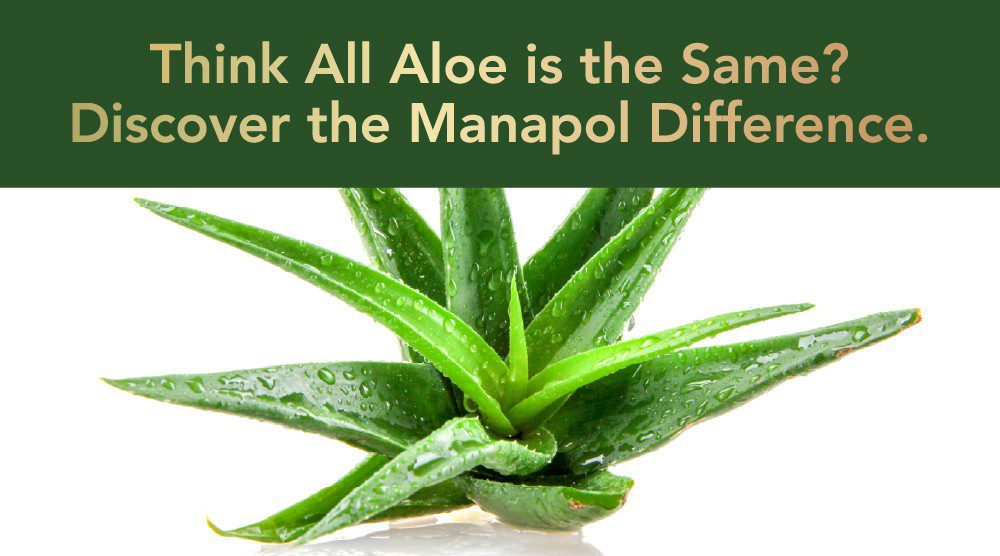
Recently, we’ve received questions about how Manapol® and Ambrotose® compare to other products on the market. Our one-of-a-kind Ambrotose® contains Manapol®, a key ingredient that helps differentiate it from the competition. For clarity, we will focus specifically on aloe to provide a straightforward comparison. To support the field, we’ve outlined three simple, side-by-side comparisons that clearly show why Manapol® powder stands apart from other aloe ingredients. While the science behind these differences can feel complex, the overview below offers a clear, easy-to-understand visual explanation.
1. High Percentage of Total Polysaccharides
Polysaccharides are the active components of Aloe vera and are attributable to the many health benefits associated with the gel of the aloe leaves.* Manapol powder contains a much higher percentage of total polysaccharides as compared to a leading competitor.
| Aloe Source | % Polysaccharides |
| Manapol® (Costa Rica) | 67% |
| Competitor Aloe | 32.9% |
2. Size and Diversity of Size Matters (Molecular Weight)
Manapol powder exhibits a far greater variation in aloe polysaccharide size as compared to the leading competitor. Mannatech’s Manapol powder contains a significant proportion of Acemannan, high-molecular-weight polysaccharides (1–2 million Daltons: ≥43%), while the competitor’s aloe product contains less than 1% in this range. These larger polysaccharides in Manapol powder are more likely to reach the lower digestive tract, supporting beneficial microbial activity glycasolation in the gut.*
Manapol powder is a highly effective broad spectrum aloe containing a blend of large, medium, and low molecular weight aloe polysaccharides.* The majority of those polysaccharides (43%) meets the official definition of Acemannan.
| Polysaccharide Size | % of Total |
| Very Large (Acemannan) | 43% |
| Medium | 35% |
| Small | 22% |
Conversely, the leading competitor’s aloe is a narrow spectrum aloe powder containing primarily low molecular weight polysaccharides.
Competitor Aloe Distribution:
| Polysaccharide Size | % of Total |
| Very Large (Acemannan) | Less than 1% |
| Medium | 12.2% |
| Very Small | 85.8% |
3. Sugar Profile Comparison
Manapol powder features a broader array of unique sugars, including mannose (64.7%), galactose (4.9%), arabinose (1.6%), rhamnose (1.7%), fucose (1.1%), xylose (3.9%), glucuronic acid (1.2%), and notably, galacturonic acid (13.8%), which indicates the presence of aloe pectin. Aloe pectin acts as a dietary fiber that supports digestive and gut health, supports the immune system, and contributes to overall wellness.*
In contrast, the leading competitor’s aloe product is dominated by glucose (43.2%) and lacks 6 of the unique sugars found in Manapol powder. Conversely, Manapol powder contains only 7.1% glucose, aligning with dietary recommendations to avoid unnecessary glucose supplementation.
This shows what the polysaccharides are actually made of.
| Sugar Type | Manapol® Powder | Competitor Aloe |
| Mannose (key aloe sugar) | 64.7% | 53.8% |
| Glucose (simple sugar) | 7.1% | 43.2% |
| Galactose (milk sugar) | 3.1% | 4.9% |
| Other Aloe Sugar | 6 are detected | Not detected |
Simple Takeaway
- Manapol delivers larger, more effective polysaccharides.*
- Manapol contains a large amount (43%) of the polysaccharides that meet the official definition of Acemannan.
- Competitor aloe is mostly small polysaccharides, less mannose, and six times as much glucose as Manapol.
This is why Manapol® continues to be the gold standard aloe ingredient.